Every dashboard eventually produces a question the dashboard can't answer. You see a number move, you want to know why, and the only options are to export something, ask someone, or move on. Most people move on. That's just what happens when there's nowhere to go.
Embedded analytics
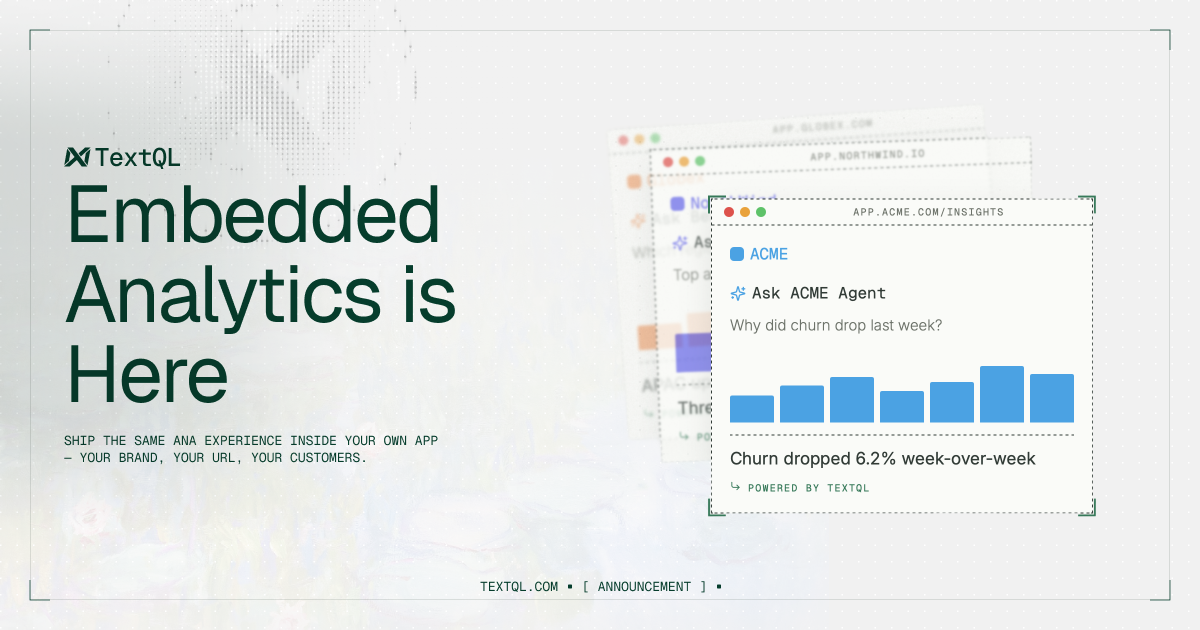
Today, we launch embedded analytics. Your customers can open your product, type a question about their data in plain English, and get an answer without exporting anything or waiting on anyone.
That's Ana, TextQL's AI analyst, embedded directly inside your product.
 Powered by TextQL
 Ana isn't another dashboard people need to learn. It works like a chat, so users can just ask questions naturally. The chat and the charts are connected to the same data, so they always show the same answers. Whether someone types a question or looks at a graph, they're seeing one consistent version of the truth.
For you, the business framing is simple: customers who live inside your analytics don't churn.
What embedded analytics unlocks for you
Analytics depth is one of the strongest predictors of whether a customer stays and expands. When your customers can get answers inside of your product without exporting data or waiting on others, your platform becomes core to how they operate their business. That stickiness shows up in retention in ways that are easy to point to.
It also gives you a clean answer to a question that derails enterprise deals. "Does it have analytics?" comes up in late sales cycles, and roadmap slides are weak answers. With Ana embedded, you have something to demo that helps prevent deals from stalling or falling through.
What your customers see
Picture a team lead who manages their business on your platform and wants to know why activity dropped last Tuesday. They type the question, Ana queries the data and surfaces an answer with a chart, and they share it with their team without ever leaving your product.
Previously that same question meant downloading a CSV, opening a spreadsheet, waiting three days for the data team to weigh in, and arriving at an answer after the moment had passed. The difference between waiting and getting instant answers is what customers will really feel, and that speed is what keeps them renewing.
How to embed Ana
There's no single right way to embed Ana. It depends on how much of the experience you want to own.
iFrame
The fastest way to get Ana in front of your customers. Drop in a URL and an API key and you're live, no SDK required. iFrame is good for proofs of concept, standalone analytics tabs, or teams that want to move quickly and evaluate before committing to a deeper integration.
White label
For platforms that want to go further, Ana can be deployed as your product entirely: your name, your brand, your experience. Your customers never see TextQL. This enables Ana to be embedded not just as a feature inside a product, but as the product itself. If you're building an analytics-forward offering and want to avoid building an AI layer from scratch, this is a path you can take.
Powered by TextQL Built for the stack you have
Ana works with any stack and you choose how deeply to integrate. An iFrame gets you live with just a URL and an API key, which is useful for proofs of concept or standalone analytics tabs. TextQL goes deepest, letting you query, stream, and orchestrate from your own backend for platforms that need programmatic control.
Security is handled at the query layer rather than the application. Row-level and column-level rules apply at query time in the data layer, with JWT auth, SSO, user impersonation, and per-tenant scoping built in. Authorized rows are the only rows Ana sees. SOC 2, HIPAA, and GDPR compliance are standard, and VPC, on-prem, and air-gapped deployments are available for enterprise buyers who need them.
Powered by TextQL See it in your product
Your customers are already asking the questions. The only thing missing is a place to ask them.
Book a demo and we'll show you Ana embedded in a product in your category: the integration path, the white-label setup, and what your customers would see on day one. Bring your hardest analytics question and we'll run it live against real data.